

Why Has the Working Class Soured on the Democrats?

First of all, is it true that working-class voters have turned away more from the Democrats than Republicans?
For white working-class voters the answer is clearly yes. They have shifted steadily toward the Republicans: from 50 percent for Bill Clinton in 1996 to 66 percent for Donald Trump in 2024.
I’ve argued that this shift was driven primarily by economic dislocation—especially job destruction caused by trade deals championed by Clinton and the corporate wing of the Democratic Party.
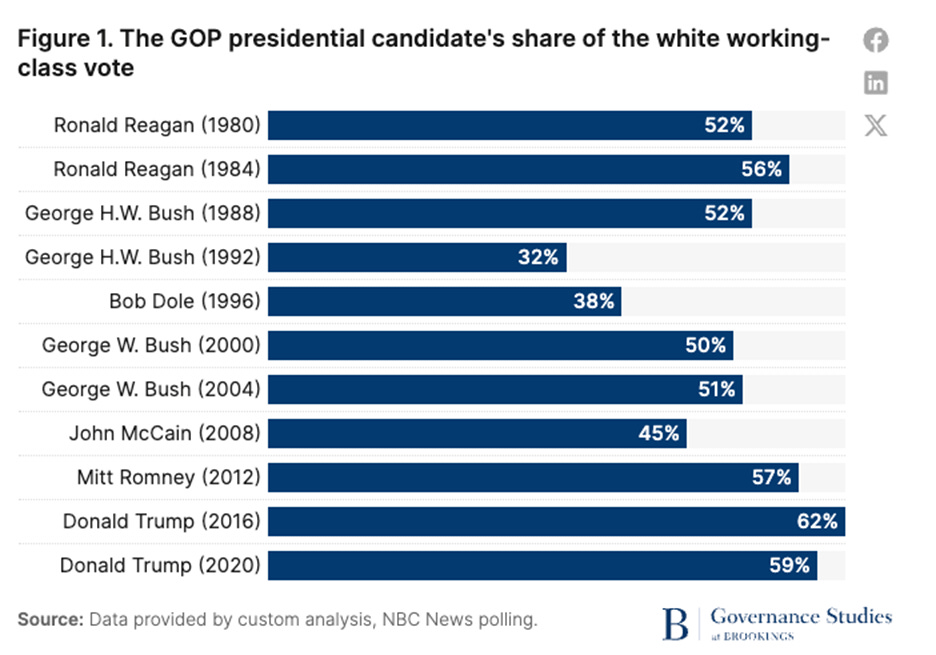
But my astute friend Matt Rinaldi challenged that argument. After all, didn’t Ronald Reagan launch the modern assault on organized labor when he fired 11,345 striking members of the Professional Air Traffic Controllers Organization (PATCO)? Given Reagan’s attacks on labor and support for corporations, if economic dislocation was the issue why didn’t workers abandon the Republicans?
Well, they did for a time, once Reagan left the stage:
Many in the mainstream media reject the economic explanation. They argue that working-class voters rebelled against the Democrats’ increasingly liberal cultural positions on issues such as guns, abortion, LGBTQ+ rights, affirmative action, and immigration.
Still others point to the collapse of labor unions themselves. As unions weakened, the union hall disappeared as the social and political glue connecting working-class communities to the Democratic Party.
These explanations can’t be disregarded, but I think the economic explanation remains compelling.
Michael Podhorzer, former political director of the AFL-CIO, captured it well:
“The resentment and movement away from the Democrats began long before they were for nongendered bathrooms. It was because their lives were becoming more precarious, their kids were leaving town, the pensions they expected were evaporating, and that took a toll.”
We have strong evidence that “wokeness” does not explain the shift. White working-class voters have become substantially more liberal on many social issues in recent years. (Source data is here.)
In 2000, only 38 percent of white working-class voters supported allowing gay and lesbian couples to adopt children. By 2020, support had risen to 76 percent.
In 1996, 60 percent believed that sexual relations between two adults of the same sex was “always wrong.” By 2021, that number had fallen to 29 percent.
In 2010, only 32 percent supported granting legal status to undocumented immigrants who had worked, paid taxes, and committed no felonies. By 2020, support for legalization had risen to 62 percent.
Democratic pollster Mike Lux reached a similar conclusion after conducting focus groups in the Midwest in 2023:
“Based on the evidence I have seen, these voters wouldn’t care all that much about the cultural difference and the woke thing if they thought Democrats gave more of a damn about the economic challenges they face deeply and daily.”
We also found similar results in our April 2025 YouGov survey of 3,000 voters in Michigan, Ohio, Pennsylvania, and Wisconsin. When asked open-ended questions about the Democratic Party, 70 percent expressed negative views. But only tiny percentages mentioned ideological extremism or “wokeness”:
Democrats — 3%
Independents — 11%
Republicans — 19%
False Promises
Beginning with Bill Clinton, the Democratic establishment promoted a new economic vision based on globalization, the knowledge economy, and financial deregulation. These forces were supposed to create prosperity for everyone by lowering consumer prices and unleashing economic growth.
Clinton and his advisers understood that many workers would lose manufacturing jobs because of this new direction, specifically the North American Free Trade Agreement (NAFTA) and China’s entry into the World Trade Organization. That’s why they also advocated for transition programs that would ease the shift of workers into new sectors of the economy, programs that were discussed but never funded in any significant way.
Manufacturing jobs crashed and working-class communities were left to decay.
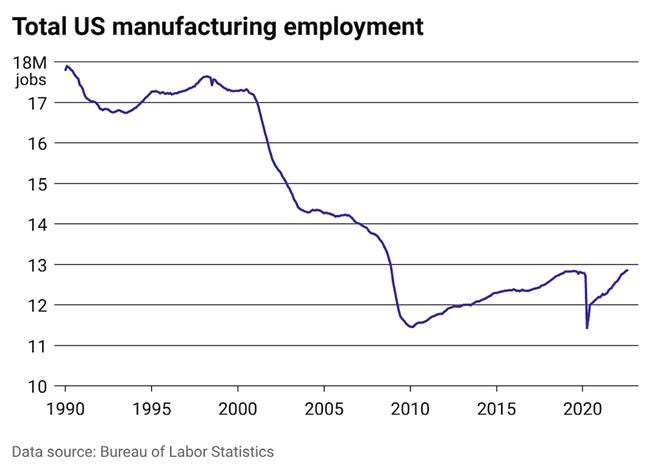
In 1993, NAFTA passed the House with 132 Republican votes and 102 Democratic votes. In the Senate, 27 Democrats joined 34 Republicans to pass the bill. Although more Republicans than Democrats supported NAFTA, Clinton ran a public-facing PR campaign in support of the program and became its public face. Clinton’s promotion of NAFTA led to the immediate loss of manufacturing jobs. And in the minds of millions of working people this fused corporate globalization and job destruction into the soul of the Democratic Party.
Former Senator Sherrod Brown still hears about it today:
“The national Democratic brand has suffered, again, starting with NAFTA… I still heard in the Mahoning Valley, in the Miami Valley, during the campaign, about NAFTA.”
The ideological transformation of the Democrats
But the problem is not just about votes about trade deals. Clinton’s adoption of a neoliberal framework, echoing Reagan’s, reflects a profound ideological change inside the Democratic Party.
For the most part, New Deal Democrats placed working people at the center of economic life. If private corporations failed to provide enough jobs as happened during the Great Depression, then government had a responsibility to step in and create them directly.
The new Democrats of Clinton’s time reversed that logic. Corporations became the center of the economic universe. The government’s role was no longer to create jobs if needed, but to create favorable conditions for corporations to generate profits—and, ideally, jobs too, (and, of course, generous donations to Democratic political campaigns.)
When Clinton declared that “the era of big government is over,” he effectively announced the end of large-scale public job creation as a Democratic priority.
For workers in deindustrialized regions, this was devastating. They needed government to fight for them—not to pass the buck to the corporations that had shuttered factories, outsourced jobs, and abandoned entire communities.
Think about how few Democrats—not named Bernie Sanders—regularly attack corporate power over jobs loss. Think about how few—not named Elizabeth Warren—seriously confront Wall Street’s obscene wealth extraction. Think about how few Democrats today support the idea that government should serve as the employer of last resort.
No one expected Republicans to champion direct public job creation. But many working people once believed Democrats would if the situation called for it.
And for decades, they did.
Even the centrist Jimmy Carter created more than 700,000 public service jobs in 1978 to fight recession and unemployment.
We sometimes forget that Democrats controlled the House of Representatives continuously from 1954 to 1994 and controlled the Senate for most of the period from 1954 to 1980.
That dominance was not accidental. It rested on a durable bond between working people and a party that placed jobs—not corporations—at the center of economic life.
When the Republicans won the House during Clinton’s first term for the first time in 50 years, it became clear that working-class loyalty had faded away from the corporate-oriented Democrats. Many working people felt they had been pushed away.
What Comes Next?
That question—what happens when a party that once represented working people becomes identified with corporate globalization—is at the heart of my new book, The Billionaires Have Two Parties, We Need a Party of Our Own.
The book argues that the crisis runs deeper than messaging or candidate quality. Working people increasingly feel politically homeless because neither major party is organized around their economic needs.
The central challenge is no longer simply reforming the Democratic Party, though running many more working-class candidates would certainly help. The real challenge is building independent working-class political power that is capable of confronting corporate dominance directly—especially in red America, where the Democrats have largely abandoned the field.
Of course, Democrats suffered from their abandonment of the working class, and Republicans didn't because they had always been against the working class and on the side of corporations. Republicans never wavered from their contempt for blue-collar families, but they are experts at branding and marketing, just like their corporate puppeteers. The White working class knows they are disposable, but are easily swayed by racial, religious, and sexist marketing. We are the authors of our own destruction.
I agree that working class voters would be more willing to ignore "wokeism" if Dems had a stronger pro-worker pre-distribution agenda. At the same time, the excesses of "wokeism" and the economic betrayal are connected: Many wc voters have said that Dems are too preoccupied with trans and other cultural issues instead of with issues that affect "people like me." Yes, they've become more socially liberal over the decades but are still, generally speaking, not comfortable with the maximalist positions progressives have staked out in recent years.